Birch Dieback: Early Warning Signs and What to Do Next
A birch that looked immaculate in June can look tired by August: a scatter of bare twigs along the top, leaves that colour early and hang thin, a crown that seems to have been pruned by someone you never hired. That is usually the moment dieback gets noticed — and by then the tree has often been arguing with its site for two or three seasons.
Dieback is not one disease with one name and one cure. It is a pattern: shoots dying back from the tips, usually starting high in the crown, as a tree runs short of the water and reserves it needs to keep every branch supplied. So the useful question isn't "what is this?" but "what has been wearing this tree down?" Answer that and you'll know what to do, and whether anything needs doing at all.
First, Rule Out Normal Birch Behaviour
Birches are dramatic. In a dry July they will drop inner, shaded leaves and leave a yellow carpet that looks alarming and isn't. They also shed short shoots, colour early in autumn, and host leaf miners that leave brown blotches without killing anything. Aphids can coat lower leaves in sticky honeydew and sooty mould by midsummer, which looks worse than it is.
The difference is where the damage sits. Ordinary shedding and insect feeding hit leaves, mostly low down or inside the crown, and the tree refoliates the following spring. Dieback hits wood: twigs and branches stay bare through the whole growing season, and the bare zone grows outward and downward year by year. If you can trace a dead branch back to a live one and see the transition, you're looking at dieback, not seasonal behaviour.
Reading the Symptoms, From the Top Down
The crown tells you first
Look at the tree from thirty metres away, then compare it with a healthy birch nearby. Thinning at the top and outer edges comes first. Dead twigs often stay attached for a season or two, which gives you a free progress record: the length of bare twig is roughly how far the problem has travelled. Small, sparse leaves and unusually heavy catkin or seed production are also classic stress signals — the tree pouring energy into reproduction rather than shoot growth.
What the bark is saying
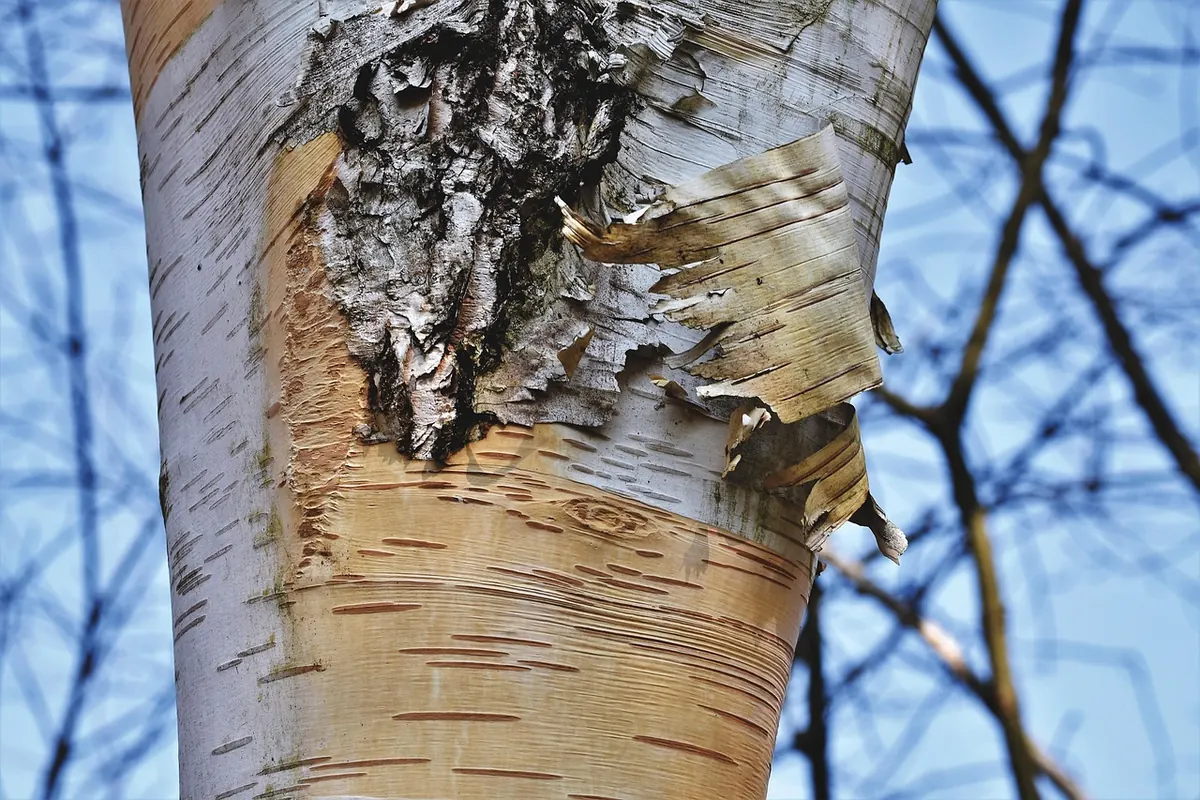
Birch bark is thin, and it shows damage early. Watch for dark, weeping patches or rusty staining on the trunk, sunken areas that suggest dead cambium underneath, and splits from frost or sunscald on the south-west side. Fine sawdust in the crevices of the bark, or small D-shaped holes roughly the width of a pencil lead, point to borers — bronze birch borer in North America and related beetles elsewhere. These insects rarely kill a vigorous tree; they specialise in finishing off a struggling one.
Look down, not just up
Most birch problems start at ground level. Check whether the root flare — the widening where trunk meets roots — is visible, or buried under soil, turf or a mound of mulch. Look for mower and strimmer scars, fungal brackets near the base, water that stands in the planting hole after rain, and soil that has been compacted by parking, storage or foot traffic. A shallow-rooted species like birch has little tolerance for any of this.
What Is Usually Behind It
In practice, the causes stack up, and the pest or fungus you find is usually the last straw rather than the first cause:
- Water, in both directions. Drought is the most common driver, especially a dry spring followed by a hot summer. Waterlogged or poorly drained ground is nearly as bad, because birch roots need air.
- Compacted or damaged soil. A new driveway, a season of deliveries over the roots, or a trench for a cable can cause decline that shows up two summers later.
- Root problems from planting. Trees set too deep, with circling roots in the nursery pot, often decline slowly for a decade before the crown thins.
- Winter injury. Frost cracks and sunscald on thin bark open the way for secondary problems.
- Competition and chemicals. Dense grass at the base competes for water; drift from lawn weedkillers can distort and thin birch foliage.
If several of these apply, expect a fast decline. If just one does, there's often room to turn things around.
A Ten-Minute Field Check
- Stand back and photograph the crown against the sky. Repeat every three months — decline is easier to judge from a series than from a single look.
- Scrape a thin twig near the edge of the dead zone with a fingernail. Green and damp means living tissue; brown and dry means dead.
- Clear the base by hand and find the root flare. If you have to dig, the tree is planted too deep.
- Check the trunk for holes, sawdust, staining and weeping patches, and note which side of the tree they're on.
- Push a finger or a trowel into the soil under the canopy. Bone dry at five centimetres means the rain isn't reaching the roots.
- Write down what has changed nearby: drainage, building work, a new fence, a wet winter, a dry spring.
What to Do in the First Season
Resist the urge to do everything at once. Stressed birches respond badly to sudden change, and a heavy-handed intervention is hard to undo.
- Water properly, if water is the issue. A slow soak that reaches twenty to thirty centimetres down, then let the soil dry a little before repeating. Little-and-often sprinkling encourages shallow roots and makes things worse.
- Mulch in a wide ring. Five to eight centimetres of coarse organic matter, spread out to the edge of the canopy and pulled back from the trunk. No cones against the bark.
- Retire the mower and strimmer from the root zone, and widen the clear ring around the trunk.
- Hold the fertiliser. High-nitrogen feeds push soft growth that borers and aphids appreciate. If a soil test shows a real deficiency, correct that specifically instead.
- Remove only dead wood. Prune birch in late summer to early autumn, or in deep winter — cutting in late winter and early spring makes them bleed heavily. Make clean cuts; never top the tree or leave stubs.
- Keep a record. Dated photographs and a few notes on weather will tell you more next spring than any guess made now.
When to Bring in Help, and When to Replant
Call an arborist if more than about a third of the crown is dead, if the trunk has large dead patches or bleeding cankers, if the tree leans or has a hollow base, or if it stands where a falling limb would hit something that matters. Tree safety is not a do-it-yourself judgement.
If the diagnosis is poor — heavy borer attack plus significant bark damage, say — replacement is often kinder than years of nursing. Then match the tree to the ground you actually have. Downy birch tolerates wetter, poorer and more acid soils than silver birch, which prefers lighter, free-draining ground. On a hot, dry, compacted site, the honest answer may be a different species entirely.
The Decision Worth Making Now
Most birches in decline are not rescued by a single treatment. They are rescued by fixing the one thing that has been wrong for years: too little water, too much water, buried roots, a mower scar that never healed. Pick the most likely cause, correct it properly, and give the tree two full growing seasons before you judge the result.
Then mark a date in your diary to look again — from a distance, with last year's photograph in hand. If the bare zone has stopped spreading, you've won more than you might think.
Photo: Teodor Buhl / Pexels